Transcript:
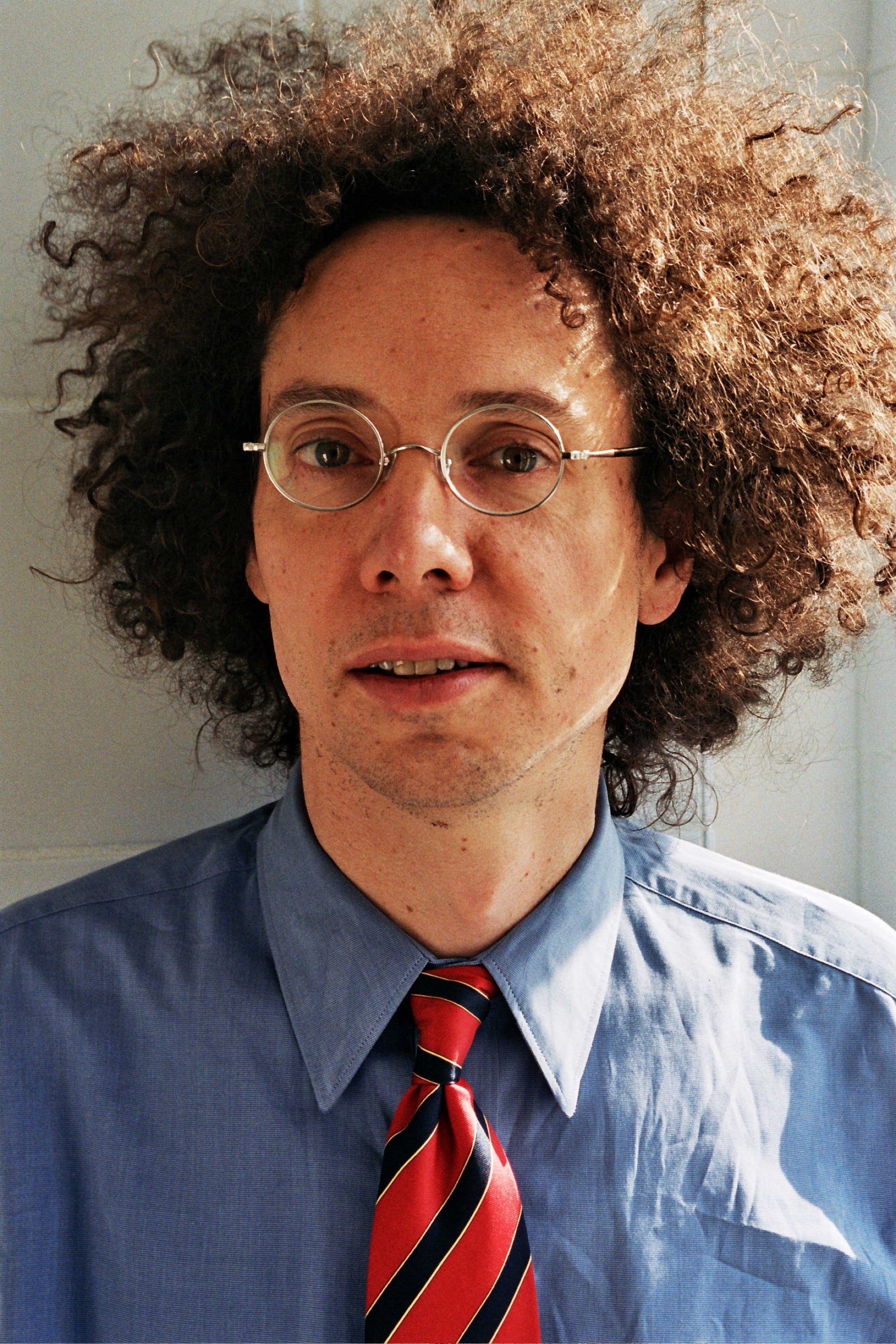
In Blink:The Power of Thinking Without Thinking, author Malcolm Gladwell explores the ability of humans to make unconscious decisions at lightening, or rather blinking, speed. He shares several examples of this phenomenon that support his research. He suggests that people have the ability to “thin slice” a situation – to strip down all incoming information to just the essential pieces and to find a pattern that matches past experiences within them. This ability often allows us to make accurate conclusions in a matter of milliseconds without even realizing what information we have analyzed or how we have processed it. This gift is not without its flaws, however. Our unconscious decisions can also be influenced by our unconscious preconceptions. Humans need to categorize information in order to make sense of the world, but this tendency to group the data that we gather as we go through life also leads to prejudices. While we may consciously combat these prejudices, they are nearly impossible to overcome when nested within our inaccessible subconscious. As a result, we need to be aware of how our preconceptions can bias our capacity to thin slice and take measures to guard against their influence. This can be as simple as training ourselves to slow down before entering a potentially eruptive situation or using a blinding screen when conducting interviews so that our mental associations with race and other physical traits do not taint our choice of employee.
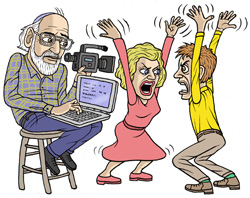
Reading Gladwell is quite enjoyable. He is not your typical dry non-fiction reporter. His use of anecdotes makes the message more personal and more palatable. He employs a witty style that is infused with a passion for his subject, but it is clear that his intent was to create another bestseller in wake of The Tipping Point, perhaps at the loss of an accurate representation of information. For example, several studies have suggested that Gottman’s research on calculating divorce is not as simple or as flawless as how it is presented in Blink. Gladwell often refers to Gottman’s work as “prediction,” but his actual research involved creating a formula based on cases in which the couple had already either gone through divorce or had remained married after a certain period of time (Heyman & Slep, 2001; Hyoun, Capaldi, & Crosby 2007). While still interesting, Gladwell’s biased word choice betrays his eagerness to sell his book and his idea, instead of faithfully representing the situations he shares.
Although Blink was published just one year after the advent of Facebook, the ideas presented by Gladwell are still relevant to the world of social networking. For example, the theories in Blink suggest that all of the personalized advertisements we have begun receiving as a result of social media actually have an unconscious effect on our attitudes even if we disregard the ad itself. Just seeing an ad may prime you to feel a certain way and will in turn affect your actions even if you are completely uninterested in purchasing the product. Gladwell cited an experiment in which participants arranged sentences that had words which suggested aging. After playing with these sentences, the participants behaved differently. They slowed down and acted old (Gladwell, 2005, p. 58) . Online advertisements featured on social networking sites may be priming us in a similar way.
Libraries creating online social presences should be aware of these effects and also the power of branding. Gladwell presented studies which proposed that the packaging of a product actually affects a user’s experience of that product. Taste testers would rate the same ice cream as more delicious if it came out of a cylindrical instead of a box-like container (Gladwell, 2005, p. 162). Libraries need to create an online image for themselves that goes beyond just stating information if they want to attract their users. Something such as a Facebook page profile is like a thin slice of a physical library experience. Users will judge the library based on their first impression of their online image, so libraries would do well to make sure that first impression is a positive one.
Beyond helping libraries promote their services and develop more interactive relationships with their users, the concepts in Blink imply that social media might be used as a tool for other purposes, as well. For instance, social media might help autistic individuals to connect and communicate with others because there is no need for them to analyze facial expressions. In the book, Gladwell demonstrates how important our fleeting expressions can be for maintaining relationships, but autistic individuals are not able to process these emotional manifestations in the same way (Gladwell, 2005, p. 219). Perhaps the removal of that element through social media would enable people with autism to communicate.
On the other hand, this also suggests that for those without autism trying to build close relationships via social media may be difficult. Some of the appeal of social networks is that people are able to discover others who share the same interests. However, non-verbal communication is essential in maintaining relationships because people often unconsciously reveal their true inner feelings through their expressions and posture that they may be disguising with their voice (Gladwell, 2005, p. 206-11). Reading these cues can enable deeper understanding and connection between two people.
When encountering people for the first time on a social networking site, there is also the issue of prejudice clouding the ability to thin-slice a profile. Some college admissions committees and potential employers are turning to sites like Facebook to prescreen their candidates. This could be helpful in one sense because a face-to-face encounter can lead to information overload and our impressions are often better at predicting the truth of a situation if left with just a few essential details. For instance, in a study cited by Gladwell, strangers asked to spend fifteen minutes in a student’s dorm room were able to accurately judge the character traits of that person (Gladwell, 2005, p. 37). In another example, it was discovered that patients arriving at the ER with a possible heart attack were actually given more appropriate treatment if the doctors performed less tests (Gladwell, 2005, p. 136).
On the other hand, if an employer looks at a Facebook profile to evaluate an applicant, they may be making a big mistake because thin-slicing must be done in context (Gladwell, 2005, p. 166). The best candidate for the job may not represent that side of themselves to their Facebook audience and therefore be rejected before they are even given a chance for an interview. Additionally, profile pictures and information may bring up unconscious prejudices that will unwittingly affect an important decision about that person’s life (Gladwell, 2005, p. 194). Moreover, the values that people express are often not in line with what they actually believe. This is not intentional, but people are really bad at explaining their unconscious and therefore come up with rationalizations that are not a true picture of their own inner mentality. What candidates may write on a profile about themselves, therefore, might not be an accurate representation of how suited they are for the job (Gladwell, 2005, p. 85), if it is even related at all.
The ultimate message is that the ideas raised in Blink should be something that those engaging in social media should keep in mind, but there is no easy solution for how to deal with their repercussions.
Resources:
Abraham, L. (Author). (2010). Gottman taping fight. [Drawing]. Retrieved July 3, 2011, from: http://img.slate.com/media/1/123125/2218698/2241481/2246161/100310_XX_marriagePredictTN.jpg
Asch, M. (Writer). (2010). Malcolm Gladwell aha. [Photograph]. Retrieved July 3, 2011, from: http://www.thelmagazine.com/images/blogimages/2010/04/19/1271693654-malcolm-gladwell-af.jpg
Cabarrus County Public Library (Organization). Find us on Facebook. [Design], Retrieved July 3, 2011, from: http://www.cabarruscounty.us/government/departments/library/Slides/facebook.jpg
ClickOBEY. (Company). (2011). Social media marketing. [Design], Retrieved July 3, 2011, from: http://www.clickobey.net/wp-content/uploads/2009/10/social-media-marketing.jpg
Cox, D. (Illustrator). (2011). Guard with keys standing beside a prisoner in jail cell. [Clip Art], Retrieved July 3, 2011, from: http://images.clipartof.com/thumbnails/6313-Guard-With-Keys-Standing-Beside-A-Prisoner-In-Jail-Cell.jpg
Dogan, D. (Writer). (2010). Ignore. [Photograph], Retrieved July 3, 2011, from: http://diyblogger.net/wp-content/uploads/2010/12/ignore.png
Duvall, R. (2009). (Writer). Information overload. [Photograph], Retrieved July 3, 2011, from: http://www.relationship-economy.com/wp-content/uploads/2009/07/information-overload.jpg
FastIcon. (Company). FaceBook icon [Design], Retrieved July 3, 2011, from: http://aux.iconpedia.net/uploads/677166248.png
Financial Brand. (Company). (2009). Core values. [Design], Retrieved July 3, 2011, from: http://thefinancialbrand.com/wp-content/uploads/2009/01/cu-core-values.gif
Gladwell, M. (2005). Blink: The power of thinking without thinking. Boston: Little, Brown & Co.
Guidarini, L. (Reviewer). (2010). The tipping point. [Design]. Retrieved July 3, 2011, from: http://bluestalking.typepad.com/.a/6a00d8341ce30153ef01348216c5c2970c-800wi
Heart Attack Expert (Organization). (2011). Ten signs of a heart attack. [Design], Retrieved July 3, 2011, from: http://www.heartattackexpert.com/wp-content/uploads/2011/03/10-Signs-Of-Heart-Attack.jpg
Heikes, E. (Writer). (2009). Relationship chart of social media tools on a whiteboard. [Photograph], Retrieved July 3, 2011, from: http://arrowquick.com/wp-content/uploads/2009/08/social_media_tools.jpg
Heyman, R.E., & Slep, A. (2001). The hazards of predicting divorce without crossvalidation. Journal of Marriage and Family, 63(2), 473-479.
Hill, B. (Writer). (2011). The beard formula. [Drawing]. Retrieved July 3, 2011, from: http://www.whiskerino.org/2009/_extra/brandonhill-beard-formula.jpg
Hird, E. (Writer). (2009). Gottman love lab. [Photograph]. Retrieved July 3, 2011, from: http://edhird.files.wordpress.com/2009/09/gottman-love-lab-3.jpg?w=191&h=164
Hisle, C. (Writer). (2010). Facebook audience. [Design], Retrieved July 3, 2011, from: http://www.propertymanager.com/wp-content/uploads/2010/01/img_facebook_buildingAudience_540x360.jpg
_____istheword (Photographer). (2008). Persona – prejudice [Photograph], Retrieved July 3, 2011, from: http://www.flickr.com/photos/cemsurgit/2868133244/
Jenny, A. (Photographer). (2009). Businessman covers eyes. [Photograph], Retrieved July 3, 2011, from: http://www.flickr.com/photos/13453262@N03/3816359644/lightbox/
Keillor, S. (Photographer). (2011). Oreo cake slice thin [Photograph], Retrieved July 3, 2011, from: http://www.flickr.com/photos/pineapplelime/5643698527/
Kim, H.K., Capaldi, D.M., & Crosby, L. (2007). Generalizability of Gottman and colleagues' affective process models of couples' relationship outcomes. Journal of Marriage and Family, 69(1), 55-72.
Kim, Y. (Designer). (2005). Blink jacket [Design], Retrieved July 2, 2011, from: http://cdn.content.compendiumblog.com/uploads/user/af12973f-cd7e-4c45-9491-c37a7fb2af13/6a3209b4-36c0-499a-9fc5-1bc8a3b76004/Image/0758ea7b31fd2411e6e8604bcf0ffd0b.jpg
Kless, L. (Writer). (2009). Managing the time. [Photograph], Retrieved July 3, 2011, from: http://www.time-management-central.net/image-files/time-management-clock.jpg
Learn2 (Company). (2004). First glance. [Drawing], Retrieved July 3, 2011, from: http://www.tutorials.com/tutorial_images/05/0523/05233bg.gif
L., J. (Artist). (2009). Never feel pressured to categorize yourself [Doodle], Retrieved July 3, 2011, from: http://24.media.tumblr.com/tumblr_krwkibpn2d1qa8ki6o1_400.jpg
Maldre, M. (Writer). (2010). Friends similar to you. [Screen Capture], Retrieved July 3, 2011, from: http://www.spudart.org/blog/images/2010/facebook-friends-similar-to-you.png
Mastromano, Y. (Photographer). (2008). Facial expressions chart #1. [Photograph], Retrieved July 3, 2011, from: http://www.flickr.com/photos/czarinasmash/2425117939/lightbox/
Nauert, R. (Writer). (2011). Advanced MRI brain scans. [Scan], Retrieved July 3, 2011, from: http://g.psychcentral.com/news/u/2011/02/brain-scans-4.jpg
Nelson, E. (Photographer). (2010). Aged. [Photograph], Retrieved July 3, 2011, from: http://www.flickr.com/photos/enelson81/4684196418/lightbox/
Pakmela.com (Company). (2010). Online friends are special. [Drawing], Retrieved July 3, 2011, from: http://www.pakmela.com/image_scraps/online-friends/rh358195.gif
PixLabLu (Photographer). (2010). Slow down. [Photograph], Retrieved July 3, 2011, from: http://www.flickr.com/photos/49605492@N05/5672781990/lightbox/
Rappzula. (Photographer). (2007). Dorm room. [Photograph], Retrieved July 3, 2011, from: http://www.flickr.com/photos/rappzula/1216735524/
Rasmussen, S.(Writer). (2009). Social media tools. [Design], Retrieved July 3, 2011, from: http://seanseo.com/wp-content/uploads/social-media-tools1.jpg
Robichaud, J & O’Kane, K. (Administrators). (2011). Maynard public library page. [Screen Capture], Retrieved July 3, 2011, from: http://www.facebook.com/maynardpubliclibrary
Robinson, L.M. (Writer). (2011). Non-verbal communication examples. [Design], Retrieved July 3, 2011, from: http://lisamarierobinson.files.wordpress.com/2011/05/non-verbal-communication-examples.jpg
Situationist Staff (Writers). (2010). Racial Bias Team. [Design], Retrieved July 3, 2011, from: http://thesituationist.files.wordpress.com/2009/03/istock_000005721882xsmall.jpg
Stanpac. (Company). (2007). Ice cream packaging. [Photograph], Retrieved July 3, 2011, from: http://www.stanpacnet.com/images/icecream_all.gif
Stephen, K. (Designer). (2011). Brand. [Design], Retrieved July 3, 2011, from: http://2.bp.blogspot.com/-PhQR1rKraZQ/TZVfuzFzkaI/AAAAAAAAADI/ehrflZ7QV6I/s1600/brand.jpg
Tenderich, A. (Writer). (2010). Words words words [Photograph], Retrieved July 3, 2011, from: http://www.diabetesmine.com/wp-content/uploads/2010/12/words-words-words.jpg
Verina. (Writer). (2010). Getting a man to love you. [Photograph], Retrieved July 3, 2011, from: http://gettingamantoloveyou.com/wp-content/uploads/2010/11/getting-a-man-to-know-you1.jpg
Viklund, A. (Writer). (2011). Malcolm Gladwell. [Photograph]. Retrieved July 3, 2011, from: http://educatedmusings.files.wordpress.com/2011/02/malcolm-gladwell.jpg
Waqas, S. (Photographer). (2009). Chocolate mousse slice. [Photograph], Retrieved July 3, 2011, from: http://www.flickr.com/photos/passionateforbaking/4181466361/
Ward, J. (Photographer). (2009). Closed eye [Photograph], Retrieved July 1, 2011, from: http://www.flickr.com/photos/julian_cycles/3539314102/in/set-72157618288761817/
Ward, J. (Photographer). (2009). Open eye [Photograph], Retrieved July 1, 2011, from: http://www.flickr.com/photos/julian_cycles/3539313846/in/set-72157618288761817/
Weber, E. (Writer). (2006). Prejudice. [Design], Retrieved July 3, 2011, from: http://www.brainbasedbusiness.com/uploads/Prejudice-thumb.sized
Williams, B. (Photographer). (2005). Gladwell photograph. [Photograph], Retrieved July 3, 2011, from: http://www.gladwell.com/images/biopic.jpg
Wong, P. (Writer). (2010). Facebook is watching you. [Drawing], Retrieved July 3, 2011, from: http://2.bp.blogspot.com/_kEuiU0w6VFM/S_IHH5UKbuI/AAAAAAAAB1M/afEvAG1_-wM/s1600/4264702656_b93a4af75d.jpg
Yelsel, A. (Photographer). (2009). For the wrong things I’ve done. [Photograph], Retrieved July 3, 2011, from: http://www.flickr.com/photos/yyelsel_ann/3784153779/lightbox/
YouYou. (Company). (2010). Perfect employee. [Design], Retrieved July 3, 2011, from: https://blogger.googleusercontent.com/img/b/R29vZ2xl/AVvXsEg8y-wJ_QWA_PysI3fBD8nQ9Q1pvmZg_LJblx9AKVHUC4oeyu4fUfNuChVQRHmX2-rcJzpvwqnQqkxjBIobZf7W9caQVSrrcSoF2CgIb314ERD2zBZ9Q3YbGk4TwRe-ddJgMObDhTv89Qs/s1600/perfect+employee.jpg










Different approach for "Blink"..your screen cast is extremely creative..am interested in what 2.0 tool you used to create it..also, how long it took to find all the appropriate graphics?
ReplyDeleteMention of Gladwell's error in the presentation of certain information was good to note. Luckily, it seems that the rest of his information is valid and the book is worth reading.
Thanks! I used Windows Movie Maker (http://explore.live.com/windows-live-movie-maker?os=other) which is a free application you can download from online. Finding the images definitely took several hours, but I made sure to cite as I went so at least I had my bibliography complete by the time I finished the movie!
ReplyDeleteDefinitely don't let his discrepancies stop you from picking up a Gladwell book. Just read with with a critical eye!
Katie,
ReplyDeleteExcellent presentation of Blink. Very creative. I also reviewed Blink, a fantastic book.
Thanks! It's amazing how different all of our presentations came out even though many people read the same book. We're a creative crew! I liked seeing all the individuals that the book discussed in your presentation. Some of them definitely didn't match the images in my head!
ReplyDelete